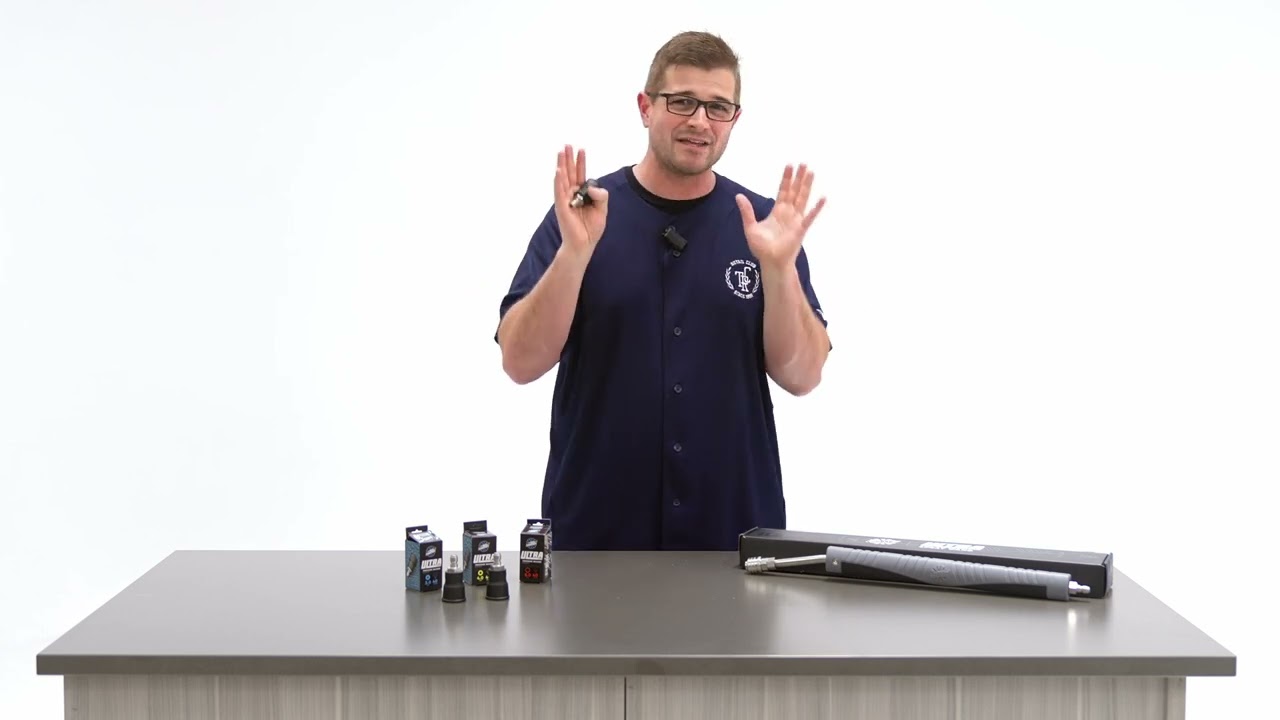
ULTRA H2O Nozzles - Case
The Ultra H2O Spray Nozzle is the cherry on top of the ULTRA H2O line. At its core is a precision-machined, stainless steel body built for long-term durability and dependable performance. Each nozzle features a clearly marked orifice size and spray angle, making identification quick and effortless when swapping between setups. Surrounding the stainless body is a textured rubberized protective shroud, providing a secure grip even with wet or soapy hands while adding an extra layer of protection around the vehicle. In the unlikely event that the nozzle becomes disconnected during use, the rubberized exterior helps reduce the chance of accidental contact with delicate surfaces. Designed around a dedicated 40-degree spray pattern, the Ultra H2O Spray Nozzle delivers the ideal fan angle for automotive washing and is available in three orifice sizes—3.0, 4.0, and 5.0—to match the needs of a wide variety of pressure washer systems. Finished with clean Rag Company branding and engineered to fit seamlessly into the integrated nozzle holder on the Ultra H2O Spray Gun, this isn't just another pressure washer tip—it's the finishing touch that completes the Ultra H2O system.
Why You’ll Love It:
- Precision-machined stainless steel construction.
- Dedicated 40° spray pattern optimized for vehicle washing.
- Rubberized protective shroud helps protect delicate surfaces.
- Integrates perfectly with the Ultra H2O Spray Gun nozzle holder.
- Stretches your pressure washer compatibility farther with three precise orifice sizes (3.0, 4.0, 5.0) that cover more machine setups
What’s Included
- (1) ULTRA H2O Spray Nozzle (Selected Orifice Size: 3.0, 4.0, or 5.0)
Product Specs
- Internal Material: Precision-Machined Single-Piece Stainless Steel
- Protective Housing: Textured Rubberized Shroud
- Spray Angle: Dedicated 40-Degree Fan Pattern
- Orifice Options: 3.0 / 4.0 / 5.0 Sizes Available
- System Integration: Fits Directly into Ultra H2O Gun Holder
How to Use
Before You Start:
- Verify your pressure washer system's GPM and PSI output to select the ideal orifice size (3.0, 4.0, or 5.0)
- Check the quick coupler and ensure the nozzle body is completely locked and secured onto your spray gun or wand.
Application:
- Make sure the vehicle panels and wheels are completely cool to the touch and out of direct sunlight
- Insert the Ultra H2O Spray Nozzle plug straight into the coupler mechanism until it firmly clicks and locks in place
- Verify the directional orientation of the 40-degree spray angle markings to align with your intended fan width
- Grip the textured rubberized shroud confidently to verify a secure seating before pulling the trigger mechanism
- Test spray away from the vehicle
- Squeeze your spray gun trigger to deliver an ultra-precise, consistent fan of water over the automotive paintwork surfaces
- Release pressure, decouple the nozzle tip, and store it directly into the integrated nozzle holder on the gun body when finished
Warranty
Warranty Coverage
The Rag Company warrants that the Ultra H2O Spray Nozzles will be free from defects in materials and workmanship for 90 days from the date of purchase, under normal use and operating conditions.
If a defect arises during the warranty period, The Rag Company will, at its discretion:
- Repair the product,
- Replace it with an identical or equivalent model, or
- Issue store credit for the original purchase price.
What’s Not Covered
This warranty does not cover:
- Damage from misuse, impact, or abuse
- Operation above or below recommended pressure parameters
- Clogging from unfiltered or contaminated water solution
- Normal wear and tear (e.g., quick connect plug wear, rubber shroud scuffing, nozzle tip discoloration)
- Use in unauthorized industrial settings
- Modifications or unauthorized repairs
- Accidental drops or tool damage from storage/mishandling
Filing a Warranty Claim
To file a claim, contact support@theragcompany.com and provide:
- Proof of purchase
- Description of issue
- Photos and/or video of the defect
- Confirmation of operating pressure and use conditions
Limitations of Liability
This warranty is non-transferable and applies only to the original purchaser. The Rag Company is not responsible for incidental or consequential damages arising from product failure.
This limited warranty gives you specific legal rights; you may also have additional rights depending on your jurisdiction.


Pressure Washer Orifice Calculator
The Rag Company · 40° detailing tips
ULTRA H2O NOZZLE FAQ's
Will the wrong nozzle damage my pump?
Only if it's too small. An undersized orifice forces your pump to push its rated flow through too tight an opening. Pressure climbs past your machine's rated max, the unloader valve cycles into bypass over and over, and the motor draws extra current with each cycle. Sustained that way, the motor windings overheat and the seals start cooking. That's how pumps burn out.
Our calculator's recommendation is always equal to or larger than the calculated orifice — we round up, never down. That keeps you on the safe side of the unloader threshold by design.
The other two sizes you see are informational. If a smaller orifice would overpressure your pump, we'll mark it amber with a warning. A larger orifice is never dangerous — it just drops your pressure below target.
How we calculate this
Most calculators size for rated PSI. We size for paint-safe PSI. Manufacturer pressure numbers are great for stripping paint off siding — and exactly what you don't want hitting your clearcoat.
The orifice math uses GPM and target PSI: orifice = GPM × √(4000 ÷ target PSI). Pressure washer pumps are positive-displacement, so they push roughly the same flow regardless of pressure — which means GPM is the input that matters for sizing the orifice. Your machine's rated PSI just tells you how much pressure capacity the pump has, not how much flow makes it through the tip.
Pick your target — paint-safe rinse, general wash, wheels — and the calculator finds the orifice that throttles your flow down to that pressure. The actual PSI we show is what you'll see at the tip with our recommended size.
This methodology comes straight from the Obsessed Garage spreadsheet.
Why don't you ask for rated PSI?
Short answer: it doesn't change which orifice you should use.
A pressure washer pump produces flow first, pressure second. The flow is roughly the same whether your machine is rated 1,500 PSI or 3,000 PSI — so the orifice math, which works backwards from flow and your target pressure, doesn't care about the rated number.
What rated PSI does tell you is whether your pump can keep up with your target. For paint-safe targets, basically every detailing-class machine has plenty of headroom. We'd rather not clutter the calculator with a slider that mostly doesn't change the answer. (For the full physics on how rated PSI relates to actual tip pressure, see the next question.)
Wait — can a low-PSI machine actually produce more pressure with a smaller orifice?
Yes — and this trips up nearly everyone the first time they hear it. Rated PSI is not a ceiling. It's a single data point.
Here's what's actually happening: the pump is a positive-displacement device. It moves a fixed volume of water per cycle (your rated GPM) regardless of what's at the other end. Pressure is just what happens when that flow hits a restriction. Smaller orifice = more restriction = higher pressure. The relationship is exact: PSI = 4,000 × (GPM ÷ orifice)².
So yes — you can absolutely take a "1,500 PSI" machine and produce 2,500+ PSI at the tip with a tight enough orifice. You shouldn't. Here's what stops you in practice:
- The unloader valve. Every pressure washer has one. When pressure climbs past its setpoint (usually 10–20% above rated PSI), it dumps water back to the pump inlet. The unloader on a 1,500 PSI machine kicks in around 1,650–1,800 PSI. Push past that and it cycles constantly — bypass, build, bypass, build — which is what burns out unloaders and pumps.
- Pump and motor stress. Even before the unloader trips, you're loading components beyond what the manufacturer rated them for. Continuous operation past rated PSI shortens pump life dramatically.
- Hose and fitting limits. Most consumer hoses are rated to ~3,000 PSI, but the connections, wand, and trigger have their own limits.
This is exactly why we don't recommend anything tighter than a 3.0 orifice. The math could call for a 2.0 on a low-flow machine, but at that flow + that orifice, the actual tip pressure would push way past unloader setpoints on most consumer pumps. The 3.0 is our floor specifically to keep that from happening.
So: rated PSI tells you what your machine is designed to sustain, not what it's capable of. Our calculator targets a working pressure (1,000 PSI by default) that sits comfortably below the unloader setpoint of any detailing-class washer, which is why the rated number rarely matters for the recommendation.
Will my pressure washer make 1,000 PSI?
Almost certainly yes. Every detailing-class pressure washer on the market is rated 1,500 PSI or higher — we couldn't find one in common use rated below that. The 1,000 PSI working pressure target sits comfortably below that floor.
And here's the part that's important: the orifice doesn't demand 1,000 PSI from the pump. It produces whatever pressure the flow restriction creates — usually somewhere between 600 and 1,400 PSI depending on your machine's GPM. As long as your machine can sustain the "Actual PSI" value shown in the calculator, you're set. For any of the three orifice sizes paired with any consumer or prosumer pressure washer, that's a given.
The one exception: very small battery-powered units (under 1,200 PSI rated, under 1 GPM) might not have enough capability for the 5.0 orifice at the higher target settings. If your machine is in that range, stick to the 1,000 PSI default and you'll be fine.
Rated vs. measured GPM — which should I use?
Rated is what the manufacturer prints on the box and the spec plate. It's based on lab conditions and a generous interpretation of "working flow." Most machines deliver 70–85% of their rated GPM in real use.
Measured is what came out of an actual flow test — a flow meter on the gun. If you've done the test (or you trust someone like Obsessed Garage who has), use those numbers. They size more accurately.
If you don't have measured numbers, rated is fine — the calculator gives you a slightly larger orifice than strictly necessary, which leans toward gentler flow. Better than the other direction.
Why we lead with 40° tips
A 40° fan is the most forgiving spray angle for vehicle work. It's wide enough to cover a panel quickly and gentle enough to use on clear coats, wraps, PPF, and ceramic coatings without much standoff drama. For most detailers, most of the time, it's the right call.
A 25° fan has a place too — wheels, lower rocker panels, undercarriage, engine bays, and other areas where you want a little more bite without going to a pressure washer setting that'd strip paint. Used at the right standoff, it's perfectly safe on automotive surfaces. We're working on a 25° tip now — keep an eye out.
Below 25°, things get more committed. 15° and 0° tips multiply impact pressure dramatically — they're built for stripping siding or cutting concrete, not for the $80,000 truck in your bay. We don't recommend those angles for vehicle work.
For soap application, a foam cannon does the job better than a 65° soap tip ever could — denser foam, longer cling, no chemical injector required.
The full breakdown — why orifice size is non-negotiable
The orifice is what creates pressure. Your pump produces flow. The tip restricts that flow into a small opening, and that restriction is what builds PSI. Without a properly sized tip, your machine doesn't make pressure — it just moves water.
An undersized tip will kill your pump. Too small an opening and water can't escape fast enough. Pressure climbs to your machine's max, the unloader cycles into bypass over and over, and seals start cooking. Run a too-small tip long enough and you'll be rebuilding the head.
An oversized tip drops cleaning power — but for paint, that's the point. A bigger orifice drops working pressure. For detailing, that's a feature, not a bug. Drop pressure to 1,000 PSI and you can wash a panel without watching the wax come off with the dirt.
Tips wear out. Even ceramic-insert nozzles erode. A worn orifice is a slightly larger orifice, which means slightly less pressure every time. If your machine isn't hitting like it used to, replace the tip before you replace the pump. They're cheap insurance.
Product Overview